· 9 min read
The Many Faces of Cash
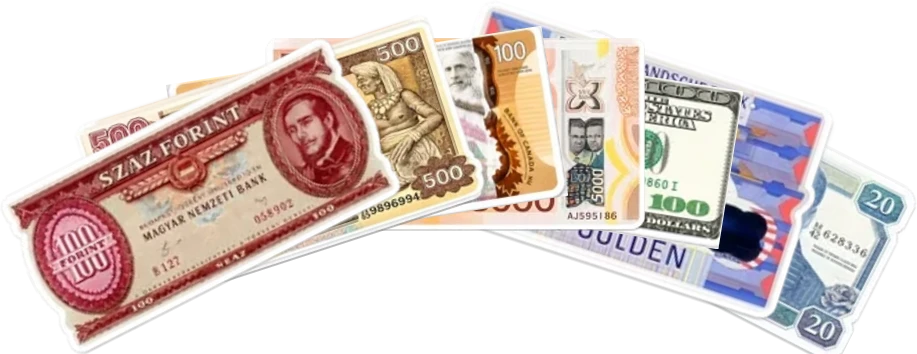
Cash may be the most widely handled human-made object on Earth, and almost nobody stops to ask why a banknote looks the way it does. Why is an American dollar the same size as an American hundred, while a Swiss note grows as it gains value? Why does a squiggle with a line through it mean money to billions of people who have never seen Spain? Why do denominations march in the odd rhythm of 1, 2, 5, 10, and almost never 3 or 7?
Every one of those choices has a reason, and most of the reasons are older, stranger, and more human than you would guess. What follows is a short natural history of the banknote, from bark paper in Tang-dynasty China to the polymer in your pocket.
Flying money
Paper money is a Chinese invention, and it began as a way to avoid carrying money. During the Tang dynasty (618–907), merchants buckling under the weight of copper coinage started issuing receipts of deposit that could be redeemed elsewhere. Contemporaries nicknamed the receipts flying money, because unlike a wagon of coins they traveled light. True circulating notes arrived in the 11th century under the Song, when a government running short of copper issued the jiaozi: a promise by the ruler to redeem the paper later for something of value. The early notes were printed on mulberry bark, and, following the direction of Chinese writing, they ran vertically rather than horizontally.
The first experiment also produced the first cautionary tale. A government can always print more paper than it holds in metal, so paper money carried the seed of inflation from birth. Every civilization since has relearned that lesson at its own expense.
The slow journey west
Europe took its time. Marco Polo came home from the Mongol court with accounts of an empire where paper was treated as gold, and the idea sat unused for four centuries. The first European banknotes appeared in 1661, from Stockholms Banco in Sweden, whose freely transferable Kreditivsedlar solved the bank's deposit problem, triggered over-issuance, and collapsed the institution. The template survived the founder. In Britain the story ran through London's goldsmiths, whose receipts for deposited gold began trading as money, and then through the Bank of Scotland, which started printing its own notes in 1696 and has never stopped: it is the longest continuous issuer of banknotes in the world. Early English notes attracted so much counterfeiting that the Bank of England and the Royal Mint invented new policing tactics, including entrapment. The arms race they started has never ended.
For most of its history a note was a claim check, a promise to pay the bearer a fixed amount of gold or silver on demand. Over the 20th century, country after country severed that link, and the process finished globally when the United States ended dollar-gold convertibility in 1971. The paper in your wallet is now backed by nothing except collective agreement that it is worth something. That shared belief is the entire substance of modern cash, and it turns out to be remarkably durable.
Why a euro grows and a dollar doesn't
Walk from one country to the next and the physical dimensions of cash shift beneath your fingers. None of it is random. A banknote's size is a negotiated truce between five competing demands:
- It must fit a wallet. When the €50 launched at 82 mm tall, Dutch citizens complained it no longer fit wallets built for their 76 mm guilder notes. Notes that overhang wear out at the edges.
- It must fit machines. ATMs and vending machines accept notes in up to eight orientations, and every extra size in a series makes the acceptors slower and more complex.
- It must serve the visually impaired. This is the single biggest reason note sizes vary at all.
- It must resist counterfeiting. Distinct sizes make bleach-and-reprint fraud physically impossible.
- It must be cheap to process in bulk, because central banks handle it by the ton.
The machinery narrows the possibilities before design even begins. Most of the world prints on presses whose optimal note is about 73 by 133 mm, and processing equipment generally wants a height between 65 and 90 mm. Within that narrow box, three philosophies emerged.
Making higher denominations physically larger now spans over 120 countries, and it solves two problems at once: a blind person can identify a note by feel, and a counterfeiter cannot bleach a low note and reprint it as a high one, because the paper is the wrong size. The euro grows in both directions as value rises. Australia's polymer series holds one height and steps up in length by 7 mm per denomination, a gap widened from 5 mm after the vision-impaired community reported that 5 was too small to feel reliably.
Then there is the American exception. Every US bill, from $1 to $100, is exactly the same size and the same color. Vending machines and cash sorters love it. Blind Americans sued over it, and won: after American Council of the Blind v. Paulson, the Treasury committed to accessibility improvements, though the same-size notes remain. The uniformity also enables a fraud with its own name, raising, in which a low note is bleached and reprinted at a higher value on genuine paper. America fights it with security threads and colored fibers rather than scissors.
A letter wearing a stroke
Currency symbols are among the most compact pieces of design in existence, and nearly all of them share a hidden grammar: a letter, modified by one or two strokes. The strokes historically signaled that a letter carried official monetary weight in a handwritten ledger. The dollar sign traces to Spain, an abbreviation of the Spanish peso written as “ps” that collapsed over time into an S with a stroke through it; when the young United States adopted a currency in 1785, it modeled it on the Spanish dollar and inherited the squiggle. The pound sign is an ornate L for the Latin libra: the original pound was literally a pound of silver. The yen and yuan share ¥ because both words mean “round object,” describing coins. The euro's € was designed by committee from the Greek epsilon, its two parallel lines meant to symbolize stability. The rupee's ₹ is the newest of the family, chosen in a 2010 national design contest, its parallel lines echoing the Indian flag.
Even the placement is cultural. English-speaking and most Latin American countries write the symbol first ($20.50); much of Europe writes it last (20,50 €). Same math, different manners.
One, two, five
Look in any wallet and you'll find the same strange arithmetic: 1, 2, 5, 10, 20, 50, 100. Almost never a 3, a 4, or a 7. This 1-2-5 pattern governs roughly 65% of the world's banknote series, and the reason is a compromise between mathematics and the human brain. In pure theory, the fewest notes are needed when denominations double: 1, 2, 4, 8, 16. Nobody wants to compute change in that series in a decimal world. The 1-2-5 sequence is the closest workable approximation that stays friendly to base ten, letting you assemble any amount from 1 to 10 with at most two pieces. When the European Monetary Institute designed the euro's denominations, it chose 1:2:5 explicitly, on the grounds that it keeps the number of notes needed for any payment to a minimum.
Variations exist at the margins: the old Dutch guilder ran 1-2.5-5, and a few series drop the 2 entirely for a leaner 1-5-10 that is cheaper to store. How high the series goes is its own science. Economists use a model that places a country's highest useful banknote at roughly five times average daily pay, which is why the top note in your wallet says something precise about the economy that printed it.
When the zeros run away
Denominations tell their most dramatic story when a currency dies. The famous case is Zimbabwe's 100 trillion dollar note of 2008. The record belongs to Hungary: the 1946 hundred quintillion pengő, a one followed by twenty zeros, printed during the worst inflation ever recorded. The Hungarian government eventually gave up printing the zeros at all and switched to named units, the milpengő and the b.-pengő, so a plate could be reused with only a color change. Ordinary people gave up on face values entirely and identified notes by color, asking for “a blue one” rather than “one hundred trillion pengő.” When the forint replaced the pengő in August 1946, the conversion rate was 400 octillion to one.
Hyperinflation is rarely an accident. It almost always reflects an unstable or war-torn government running the presses to service debt. The notes it leaves behind are collectibles now, which is its own kind of epitaph.
The faces on the money
If dimensions are about the hand, imagery is about the heart. The subjects printed on banknotes are among the most deliberate political choices a nation makes, and portraits dominate for three reasons. A historical figure signals instantly which nation issued the note and casts that nation in a chosen light. A human face gives a designer an immediate focal point, because viewers lock onto the eyes. And a face is a security feature: human brains are exquisitely tuned to detect the slightest error in one, which makes portrait engraving both brutally hard to forge and easy to check. A 2020 study found political figures are the most common banknote subjects, followed by royalty, then writers and scientists. Countries without a monarchy put statesmen where a king's face would go; US law goes further and forbids depicting any living person on currency, a rule rooted in the young republic's allergy to royal imagery.
The conventions run surprisingly deep. Coins favor profiles, because shallow relief is easier to strike and identify; banknotes can afford detailed frontal portraits. And monarchies plan for succession: Australia deliberately limited the Queen's portrait to a single denomination so that only one note would need redesigning when the crown passed.
The arms race goes plastic
Color is functional before it is decorative. Distinct predominant colors let people, especially people with low vision, tell denominations apart at a glance, which is why nearly every currency except the US dollar color-codes its notes. During Hungary's hyperinflation, color became the only way anyone distinguished notes at all. Above the color sits the security stack: watermarks, embedded threads, color-shifting inks, holograms, microprinting, raised intaglio, and the portrait engraving already doing double duty. The biggest material leap came from Australia, which was stung by a counterfeiting wave and in 1988 issued the world's first polymer banknote. Plastic notes last years longer than paper, survive the washing machine, and carry transparent windows that are extremely hard to fake. Dozens of countries have followed, the most significant change to the physical substance of cash since mulberry bark. The accessibility toolkit keeps growing too: Australia's newest series carries a different number of embossed bumps per denomination, so a note can be read entirely by touch.
Cash as a mirror
A banknote is a remarkably dense artifact. Its size is a truce between wallets, machines, and the fingertips of the blind. Its symbol is a thousand-year-old abbreviation wearing a stroke of authority. Its denominations encode a compromise between binary efficiency and decimal habit. Its face is a nation's chosen self-portrait, and its colors, threads, and windows are the front line of a war that started in the 1600s and never ended. From flying money to polymer, cash has always been a portable statement of what a society values, whom it honors, and whom it takes care of.
We spend our days at Guap building the bridge that carries this artifact onto the internet. It helps to love the thing you're building for. The many faces of cash, in the end, are our own.
Sources: Wikipedia entries on paper money, banknotes, Stockholms Banco, and currency symbols; European Central Bank dimension tables and the ECB Monthly Bulletin on the 1:2:5 sequence; Reserve Bank of Australia on polymer notes, tactile features, and Notable Australians; National Academies Press and IMF Finance & Development on currency features for the visually impaired; Banknote World and StudyLib on note dimensions; Investopedia and Remitly on symbol origins; Mathtuition88 on denomination arithmetic; Planet Banknote and PCGS on the Hungarian and Zimbabwean hyperinflations; Ashmolean Museum on the changing faces of money; American Council of the Blind v. Paulson.